Showing posts with label #TBR2024. Show all posts

Monday, 2 December 2024

TESS OF THE D'URBERVILLES BY THOMAS HARDY


We are in the last month of the year 2024, so was the end monthly activity of #TBRChallenge with the prompt “Holiday CLASSIC”

A holiday classic is a book that is popular over a long period and is considered to be exemplary or noteworthy. Some examples of holiday classics include: 

A Christmas Carol by Charles Dickens: A story of redemption and forgiveness set in Victorian England. It's considered a masterpiece on generosity and empathy. 

The Grinch by Dr. Seuss: The Grinch plots to steal Christmas from Whoville, but discovers the simple joys of the festival. 

The Life and Adventures of Santa Claus by L. Frank Baum: A story about the beginning of the popular character Santa Claus. 

The Nutcracker and the Mouse King by E. T. A. Hoffmann: A story about bravery and dreams in a fantastical world. 

Google suggests the above list,  but for me, A sense of timelessness — or the fact that many people have enjoyed a work over time and continue to enjoy it many years later — contributes greatly to something being considered a classic. Classics also tend to become part of the cultural landscape.

I’m planning to bid adieu to the old copy of the book TESS OF THE D’UBERVILLES as it was almost worn out. Before that, I thought to re-read it one final time before it went out of my bookshelf.

So I treat this book as a holiday classic and share a few highlights of the novel - Tess of the D'urbervilles by Thomas Hardy

Tess of the D'urbervilles is an epic tale of Tess Durbeyfield's tragic life, her disasters in love, her tear-wrenching experiences with death, and her painstaking efforts to grow into a 'proper' woman. Tess Durbeyfield is the main character in the book and you see her grow as a person over several years.

Social hierarchy, modernity, history, free will and fate, gender, and injustice are all themes found in Tess of the d'Urbervilles. The novel's moral is that the cruelty of society and human beings can lead to tragic results.

The title of the novel Tess of the D'Urbervilles:

A Pure Woman Faithfully Presented is both ironic and defends the morals and moral standing of its main character, Tess.

The novel generally follows the moral structure of the traditional English novel - that virtue is rewarded, immorality is punished and good people learn from their mistakes. Victorian society would have considered Tess a 'fallen woman', rather than a naive young woman assaulted or taken advantage of.

Tess of the d'Urbervilles by Thomas Hardy is considered a modern novel because of its radical ideas and realism. Some say that the novel's themes are still relevant today, including: 

Empathy for women

The novel portrays Tess as a victim of Victorian society, mistreated by men and society. 

Nature vs. industrialization

The novel is set during a transition from agriculture to industry, with rural towns, farm women representing nature, and machines and upper-class men representing industrialization. 

Injustice of Social Law

The novel highlights the injustice of social law, the hypocrisy of social prejudice, and the inequality of male dominance. 

Tess is a courageous woman who stands up for herself, defies the Church, and connects with nature. Her leanings towards Paganism show her disconnection with Christianity, and Hardy's move away from traditionalist views. 

Tess's eventual death, one of the most famous in literature, is a direct result of human cruelty and as such represents one of the most moving indictments of the lives of 19th-century English women in all of literature.

Tess of the d’Urbervilles is a novel with perfect classic features that can be read at any time.


(This blog post was part of Blogchatter's #TBRChallenge monthly activity. More details here:https://www.theblogchatter.com/blogchatters-reading-challenge-tbr-challenge)

Wednesday, 20 November 2024

101 INSPIRING STORIES BY G. FRANCIS XAVIER


101 INSPIRING STORIES – Principles of Successful Living by G. FRANCIS XAVIER is the book about which I’m going to present a blog post for the #TBRChallenge monthly activity of BLOGCHATTER.

This is one of the many inspiring books from the renowned “Motivator” Dr. G. Francis Xavier. This harvest of stories has been gleaned from lands he visited and books he read. Xavier, who conducts full-house personal growth courses has brought out this compendium in an interactive form, making the reader give the answers at the end of the story, which is a novel approach.

 Stories and examples are the best way to inspire, and this volume can be gifted to anyone. It is useful for preachers, speakers, and teachers. The book appeals to readers of all ages. It has stories to inspire and promises uninterrupted chuckles till the end. There are also quotations on success.

Have you heard about STORY MEDITATION? Yes, you read it right. This is the special feature of this book.

First, see what the author has to say about it

“The end of the story is not revealed and the participants are urged to come up with their own answers. I call this process “story meditation”

To get maximum benefit from this book: Go through the story. Reflect for a moment on the two questions at the end. Think of the possible answers. Then refer to the answers given. If you follow this procedure, your creativity will improve and you will get the maximum out of the book.” Confirms the author.

Moreover, he confesses that “my contribution is the language and the explanation of the implication of each story.”

This you will notice as you start reading the book because the book contains 101 inspiring stories many of which were from well-known sources like Edison, Newton, President Lincoln, Roosevelt, Lord Mountbatten, Piere Curie- French scientist, Aristotle, Socrates, Henry Ford, Padesewski- A renowned scientist, Thomas Gray, DR Samuel Johnson, Son of King Louis XVI, Sage William Allen White, POP Star –Cliff Richards and Indians like Gandhi, Nehru, Nirala, Buddha, Emperor Akbar to name a few.


One of the stories in the book reminds me of the following poem:

“Depend not on another, rather

Upon thyself, Trust to thine own exertions

Subjection to another’s will only gives pain

True happiness consists in self-reliance.”


Like these, there are such interesting and inspiring stories in this book that will help us to improve our personality to a considerable extent.

Each chapter has a small story followed by questions &answers. This will surely take you back to school days but certainly won’t be boring.

With catchy titles and simple writing, the book has a magnet-like power to attract readers and keep them hooked till the end. Though the story is completed in a few minutes, we will love to move to the next one immediately and this curiosity will continue till the last story. Each story is entirely different and has a strong message to keep up with life’s challenges and live a fulfilling life.

In English, 101 refers to showing the most basic knowledge about a subject, i.e. crude and basic. Here in this book, 101 stories refer to quantity as well as the basic qualities that are needed to be acquired in one’s life.  

“Be Tactful”, “Know that you know little,” and “When should you begin the education of your child?” were my three first favourites.

Do take time to read the book and pick your favourites.


(This blog post is a part of  Blogchatter's Monthly #TBR activity for November. Details here : https://www.theblogchatter.com/blogchatters-reading-challenge-tbr-challenge)


Thursday, 31 October 2024

MY GRADUAL PROGRESS WITH GRAPHIC NOVELS


October is almost at the end and my month-long effort to write a blog post for Blogchatter’s monthly #TBR activity was somewhat fruitful. Read along to know more about it.

Graphic novels were the prompt for the month of October, I’m a bit away from the genre. The day before yesterday read a blog post about – PERSEPOLIS, about which I know only the thing that the title refers to the ancient capital of Persian Empire and nothing more.

Being like this, it was a herculean task for me to write a blog post on such a subject with which I was not familiar. So I thought to start from the origin/beginning and went out to fetch a book that deals with graphic novels and their development.

At this juncture, THE POWER OF COMICS – HISTORY, FORM, AND CULTURE by Randy Duncan, Matthew J. Smith & Paul Levitz caught my eye in the library. This I felt like a boon and started reading it slowly. Actually very slowly trying to understand the information clearly. Here I will be sharing the particulars of graphic novels from the book. 

The book has a preface by Mark Waid. In which he takes the readers on a trip down memory lane and explains how the indisputable fact “Comics were no longer just for kids” came into being.

What are those three works that created this impact was also shared in detail for the readers.

Moving then, to the Pulitzer Prize of 1992 for Art Spiegelman’s graphic novel “Maus”

From the introduction of the book, I quote   In recent times several people have attempted to rehabilitate the image of comic books by using a different term, Graphic novel, to describe the more ambitious works in the art form. For creators, labeling their work a graphic novel allows them to distance themselves from the commercial and periodical connotations associated with comic books.

For publishers, the graphic novel is a term that helps elevate the status of their product and has allowed them entree into bookstores, libraries, and academy. In practice, graphic novels may be longer than the typical comic book and most often feature self–contained, rather than continuing, stories.

While we too use that term in this book, you may well note that the graphic novel needs the definition of the comic book form. While they might be considered manifestations of the same art form, a case could be made that graphic novels exist in a different cultural space and are thus becoming their medium distinct from comic books.

IN the 21st century, graphic novels are often published by major publishing houses such as Random House and brought into traditional or online bookstores by people who do not read comic books. A number of them are even created by cartoonists who are not comic book fans.”

Appreciating the originality of the art form; understanding historical significance; and visualizing the medium's potential are the gains of studying comics assures this book.

The book provides vast information on the era of the invention of comics and RODOLPHE TOPFFER – the father of the comic book.

Next, it talks about the modern comic book, super imitators, EC comics, ‘NewTrend”, Schwartz, and the fans.

 Crossing all these the book lands at the rise of the graphic novel. I quote from page 64 :

In 1978, Will Eisner’s A CONTRACT WITH GOD, distributed in both bookstore chains and direct market comic book shops in traditional hardcover and trade paperback formats, garnered wide attention and firmly established graphic novel as the term for a longer comics work with literary intent.

In the same chapter, the authors discuss the Era of the graphic novel?  Replying to this, I quote ‘By the beginning of the 21st century, it was likely that more readers were purchasing comics in graphic novel form than in periodicals although the intense purchase patterns of the fans still generated disproportionate revenues.”

Then the book throws light on analyzing graphic novels in the mainstream market. Moving ahead, the authors make the readers understand the effect of the graphic novel.  I quote “Miller’s Groundbreaking work on Batman: The Dark Knight Returns and the commercial and critical success in graphic novel form in turn inspired others. By the late 1980’s a small number of graphic novels were being published with ever-increasing creative ambition.”

Beyond the Graphic novel Via the Web was the next topic of discussion in the book.  Later the explanation is given for Graphic “Novels”- The quotation marks around the term novels is an acknowledgment that the term novel has traditionally referred to works of fiction, but it is being applied to memoir, a form of non-fiction.

Finally, the book covers- The Evolution of Comics in India by Gotham Chopra and Sharad Devarajan.

The book is as engaging as any other fiction book. Not only fans but also new entrants to the world of graphic novels should go through this book to gain a stand over the lost time.


 (This blog post is a part of Blog Chatter's #TBRChallenge- prompt for October, Details here)

Friday, 20 September 2024

THREE BOOKS OF THREE INSPIRING AND EMPOWERING WOMEN


Books centered on women's lives and experiences resonate deeply with readers due to their rich diversity, relatability, emotional depth, and cultural relevance. As society continues to value diverse narratives and seek more inclusive representation, the popularity of literature about women is likely to endure and grow.

Women need to share their stories so other women can find themselves in these stories — so they can feel less alone in a shared struggle, feel inspired by the women who've broken glass ceilings before them, or so these stories can one day serve as a guide for other women.

Are all these books gaining the deserving limelight? Or they still under the radar?

"Under the radar" is an idiom that means something is not getting attention or is unnoticed. 

 There are many books under the radar in this world of books, but here are the three books on three inspiring and empowering women that I personally feel were under the radar.

These are highly recommended for reading for everyone who is looking for inspiration, these empowering books for women are a great place to start. They will anger you, inspire you, and empower you to see that things can change for the better.

These can be read at any time, at any age and surely you won’t be disappointed.

I Am Malala: by Malala Yousafzai, co-written with Christina Lamb.

My Life in Full  by Indra Nooyi

Of Gifted Voice: The Life and Art of M.S. Subbulakshmi by Keshav Desiraju


 I Am Malala: The Story of the Girl Who Stood Up for Education and Was Shot by the Taliban is an autobiographical book by Malala Yousafzai, co-written with Christina Lamb. It was published on 8 October 2013, by Weidenfeld & Nicolson in the UK and Little, Brown and Company in the US.

 In “I am Malala,” Malala Yousafzai explores the idea that education empowers women to stand up for their rights so that they can have a positive future.

Malala was shot in the head by the Taliban in 2012 for daring to seek an education. Since then, the young woman has been wowing the world with her courage, her passion, and her dedication to the fight for children's education and the rights of girls around the world.

When we lift up others we all rise higher - Malala is the brave saint that lives this truth and inspires millions to do the same. Malala is inspiring because she is speaking up for the rights of those who have no voice. She bravely holds a lamp for girls to be educated.

The author is trying to educate readers, as well as trying to convince the reader to assist in the Malala Fund's goal to make education available for all children.

She spoke out on educational rights and the oppressive behaviors of the Taliban through her life story. Malala's experiences help readers catch a glimpse of the Swat culture and issues. Malala's insider point of view in Pakistan reflects global issues that need to be spotlighted.

The United Nations Special Envoy for Global Education, Gordon Brown, launched a petition in her name, using the slogan “I am Malala,” demanding that all children worldwide be in school by the end of 2015—a petition that helped lead to the ratification of Pakistan's first Right to Education Bill.

The main theme to take away from the book is Malala's response to human rights violations with regard to women and education in Pakistani culture under Taliban rule. Malala's story highlights the importance of freedom of speech and the risks some children take in order to get an education.

In the first section of the book, Malala describes a happy and safe childhood and the awe she felt for education from the time she was a toddler. While the family does not experience violence firsthand, in the other section of the book, Malala shares the tumultuous history of Pakistan to lay the groundwork for her own story.

No matter what your circumstance or who you are leading, never give up on what you believe in- is the loud message of the book.

Malala is an icon, renowned for her support for education and women's rights. As a result, one of the most prominent themes in I Am Malala is the theme of fame itself: how heroes and role models, known by millions of people they've never met, can contribute to change or distract from it.

 Malala Yousafzai is an exceptional young leader whose journey is rooted in her unwavering commitment to advocating for girls' education and her fearless fight against the Taliban's oppressive regime in Pakistan. Although she may not have done so intentionally, Malala knew how to inspire people.

Malala demonstrated extraordinary courage and resilience in the face of adversity. Despite threats and the risk to her life, she stood up for what she believed in and continued her fight for education. As a leader, even in challenging circumstances, we should stand up for what we believe in, our convictions.

She sets the book so that you can learn about her country without the tainted view of the media and people's assumptions. Regardless of it not being the “best” written book, I think it is still significantly important and highly recommend it.


'My Life in Full' by Indra Nooyi is a memoir that offers insights into the life and career of one of the world's most powerful businesswomen. It provides a first-hand account of the challenges and triumphs of navigating corporate America as a woman and a person of color.

In her memoir, My Life in Full, Indra discusses her vision for a society that enables women and young family builders to integrate work and family better, so that they can prosper and we can build a more supportive, inclusive, and productive economy.

The first woman of color and immigrant to run a Fortune 50 company — and one of the foremost strategic thinkers of our time — she transformed PepsiCo with a unique vision, a vigorous pursuit of excellence, and a deep sense of purpose.

 Under her leadership, the company increased its profitability while also working to improve environmental sustainability and the healthiness of its food offerings. Nooyi is also a major philanthropist.

An autobiography of a female, immigrant CEO that is full of heart. The Indian former CEO of PepsiCo narrates her rise to the top. Growing up in a Hindu Brahmin household in Madras (renamed Chennai in 1996), India, Nooyi learned the importance of family, and as a self-described “tomboy,” she loved to buck tradition.

Indra Nooyi, a business leader and strategic thinker, is widely considered to be one of the top CEOs in the world for her leadership of the global behemoth PepsiCo for 12 years.

Nooyi's commitment to innovation, sustainability, and inclusivity serves as an inspiration for aspiring entrepreneurs and leaders worldwide. Her story is a reminder that with passion, hard work, and a clear vision, anyone can overcome barriers and achieve remarkable success.

Indra Nooyi indirectly instilled in many through the book the confidence to believe that as a leader, we have the power to influence and impact the lives of many. She exemplified how leadership is not just about driving business success, but also about fostering a culture of care, compassion, and inclusivity.

The book effectively speaks up to maintain a balance between personal and professional responsibilities through effective time management, delegation of tasks, setting priorities, and maintaining open communication with family and colleagues and ensures the match of apt content with the title- MY LIFE IN FULL –WORK, FAMILY, AND OUR FUTURE.


Of Gifted Voice: The Life and Art of M.S. Subbulakshmi by Keshav Desiraju is a book that examines the life and art of the classical vocalist M.S. Subbulakshmi. The book's specialty is in exploring the musical tradition Subbulakshmi was part of, and the impact of the gramophone, radio, and talkie on music. It also covers the decline of traditional performing families, the appearance of women on public platforms, and Subbulakshmi's concert style. 

Of Gifted Voice looks at her life and times, and the great musical tradition she belonged to and to which she brought so much, against the larger backdrop of the developments in the world of Carnatic music. The book also delves into Subbulakshmi’s brush with films as well as her concert style and that of her celebrated contemporaries.

M.S. SUBBULAKSHMI’S life was one of extraordinary achievements. Although she was portrayed in many ways – as a musician who sought and achieved an all-India appeal; a philanthropist and supporter of noble causes; an icon of style; a woman of piety and devotion; and a friend and associate of the good and the great – she was first and foremost a classical vocalist of the highest rank, of unmatched gifts, who lives on in the musical history of India.

Though her story has often been told, we know little of the woman behind the image and the musician behind the public persona. Of Gifted Voice attempts, with warmth and keen-eyed perception, to understand the music, the history, the artiste, and her incomparable presence.

At the crack of dawn, MS Subbulakshmi’s Vishnu Sahsranamam woke up the Gods and his devotees in South India. Soon, Carnatic music became synonymous with MS. This is a sentiment shared by many music lovers and it also comes across in Keshav Desiraju’s Of Gifted Voice: The Life and Art of MS Subbulakshmi.

A research-intensive biography, Of Gifted Voice, takes readers through the mellifluous years of Subbulakshmi on stage, in front of the camera, her camaraderie with famous politicians and musicians with information about her contemporaries, making it a wholesome package. The chapters also serve as a guide on concert lists, songs and their ragams, and the singer's and her peers' presentation style.

 Of Gifted Voice attempts, with warmth and keen-eyed perception, to understand the music, the history, the artiste, and her incomparable presence.

A torchbearer of Carnatic music- Madurai Shanmukhavadivu Subbulakshmi played a vital role in taking Carnatic music beyond geographical and cultural boundaries, making it accessible to people from all walks of life.

It would be difficult to overstate the talent and the impact made by Smt. M.S. Subbulakshmi, not just in the field of Carnatic music, but also as a philanthropist and a person who placed her life at the service of her country and its people. She was both much larger than life and utterly human in her interaction with others.

These three books will create interest in non-fiction books thereby expanding knowledge, helping you to think critically, and improving self-awareness. When writers craft a nonfiction novel about their experiences, life events, or research, their intent is (I hope) for good. They want to share their story, thoughts, or experiences and hope others can learn from them.

Non-fiction books attract me because I love to know how others live their life, how they face the challenges of life, and how they find unique ideas to reach their goal.

What do you say?  Which books do you think are under the radar?  Do share it in the comments.


 (This blog post is a part of Blog Chatter's #TBRChallenge- prompt for September, Details here)


Monday, 19 August 2024

STRANGE FACTS OF A CLASSIC MAKER & HIS MASTERPIECE


Books are like our fellow friends with no demands or complaints. They improve our knowledge, wisdom, and information, thus helping us make the right decisions in life. Books are the best option for self-learners to avail of information on all issues and topics.

When this companionship extends over some time, we become clear and make a perfect selection of books according to our tastes and preferences.

Then begins the hunt for books of genres we like, books by our favorite authors, and any extra information by the publisher is always welcome.

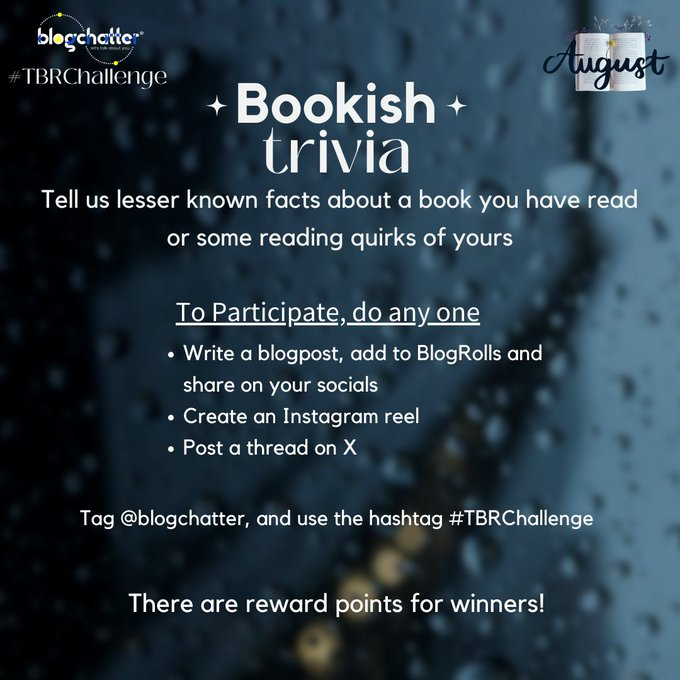
In between in this cycle, bookish trivia adds a dash of hot spicy flavor to our reading time.

 Trivia is unimportant facts or details that are considered to be amusing rather than serious or useful.

'Trivia' comes from the Latin 'trivialis,' meaning "found everywhere, commonplace." One meaning of 'trivia' is "unimportant matters."

In the world of books, trivia is a strange fact about a book. The book -Cervantes’s Don Quixote translated by John Rutherford which I received from Penguin India's last year’s giveaway with its volume, style, and its classic nature led to an attempt to find out any bookish trivia behind it.

Literary historians consider Don Quixote one of the most important books of all time, and it is often cited as the first modern novel. The character of Quixote became an archetype, and the word quixotic, used to mean the impractical pursuit of ideological goals, and entered common usage.

In his most famous work, "Don Quixote," Cervantes wrote in prose. While much of world literature up to that point had been written in verse, Cervantes' masterwork is called by some the first true novel in Western literature.

Bookish trivia / lesser-known facts of the book were traced from here and there. This has increased the prominence of the book and the readers rejoice reading these trivia of one of the great books in the world of Literature.

Without any further delay, here is the bookish trivia of the CERVANTES ‘S DON QUIXOTE:


·       Unfinishable masterpiece for many because of its length.

·       The fake sequel prompted Cervantes to pen his sequel, which was released in 1615, a year before his death.

·       The novel is also the inspiration behind tons of songs and has spawned endless adaptations.

·       A famous 1605–1615 Spanish novel by Miguel de Cervantes (1547–1616), whose full title is El ingenioso hidalgo don Quijote de la Mancha (The Ingenious Gentleman Don Quixote of La Mancha). The protagonist of this novel.

·       Don Quixote is not a true story. Some of the confusion surrounding the novel as fiction or non-fiction stems from the real places and real historical figures with whom Don Quixote interacts. Further, Cervantes called his novel "a history," which also adds to this confusion.

·       Shakespeare was a contemporary of Cervantes but also a huge admirer of his work. In fact, in 1613, he wrote a piece called The History of Cardenio, based on a character from Don Quixote.

·       Miguel de Cervantes spent five years in captivity in Algiers.  A particularly empathetic sequence in the novel sees the hero and Sancho Panza freeing a group of galley slaves from captivity. Cervantes’ special sensitivity to these recipients of Don Quixote’s chivalry likely stems from his own experiences in servitude in the 1570s.

·       The very first translation of Don Quixote was Dublin-born author Thomas Shelton’s English take on the text, published in 1608. Shelton didn’t exemplify quite the same degree of linguistic creativity as his successor Motteux. The former’s rigid adherence to Cervantes’ diction was his publication’s greatest downfall.

 A novel centuries ahead of its time, Don Quixote is a masterpiece that brought satire, realism, characterization and other elements together in ways that make it feel remarkably fresh and experimental even today.

Its lovable duo of Don Quixote and Sancho Panza along with its insightful commentary on humanity and society make it an unforgettable classic. No wonder it is considered not just the greatest Spanish novel but one of the finest literary works ever created across languages and cultures.

What do you say? Do you know any trivia about this book? Do share it in the comments


( (  (This blog post is a part of Blog Chatter's #TBRChallenge- prompt for August, Details here)


Tuesday, 23 July 2024

SYEDA IMAM ON AUTHOR SPOTLIGHT


One of the most widespread sayings refers to the phenomenon of 'ageing like fine wine'. This is used to compliment someone (or something) on maturing gracefully and getting better over time, much like fine wine.

Inspired by this saying comes a book LIKE A FINE WINE by Syeda Imam. Read a review of the book in a newspaper and fell for the book. It was the second book of the author. The former is THE UNTOLD CHARMINAR - which describes the culture of Hyderabad.  Read the review

Syeda Imam is a writer and activist based in Delhi.  She was a member of the (NCM), India. She is an award-winning writer and editor.

 Born in Hyderabad, she was a Fellow of English Literature at Bombay’s Elphinstone College. After working as Executive Creative Director at India’s three foremost advertising agencies, Syeda joined the Government of India in the Ministry of Minority Affairs and External Affairs. 

Syeda Imam’s book, Like Fine Wine, is her book of stories about a few unmissable lives and loves. A collection of nine monographs with an elegant, minimally designed, understated cover.

Love Sparkles in Like Fine Wine like never before. It intrigues, mystifies, and varies as acclaimed writer Syeda Imam makes short and sensitive forays into the real love stories of nine unusual couples. Amongst them are the nawab of cricket Tiger Pataudi and superstar Sharmila Tagore, acclaimed director David Lean and Leila Matkar, chess grandmaster Viswanathan Anand and Aruna along with six other rare examples of love who fascinate.


Through the book THE UNTOLD CHARMINAR readers will discover a city they will want to explore, as Sarojini Naidu, Sir Mark Tully, and William Dalrymple rub shoulders with Ian Austin, Meenakshi Mukherjee and Anees Jung, regaling you with their feast of hard facts and hearsay; as each foreign visitor shares his story through Narendra Luther; as the film-makers Shyam Benegal and Nagesh Kukunoor paint their vivid memories of home; as poets, not just the maverick Makhdoom and Gaddar, raise their voices in song; as statesmen, academics and aficionados hold forth on the completely different Hyderabad each experienced.

Both the books of Syeda Imam are captivating reads of love for the couple and the city. Her thorough research magnifies the glory of her two books in their respective genres.

You can read her interview here

(  (This blog post is a part of Blog Chatter's #TBRChallenge- prompt for July- DetailsHere)

Thursday, 27 June 2024

SHORT STORIES BY BRET HARTE


short story is a piece of prose fiction. It can typically be read in a single sitting and focuses on a self-contained incident or series of linked incidents, with the intent of evoking a single effect or mood.

 The short story offers a unity that the novel can never have, simply because of its length. The writer (and the reader) can hold the entire world of the short story in their mind at once. This makes the experience of writing (and reading) a great short story immensely powerful.

 Because they are more compact they allow readers to readily absorb the whole narrative structure The preamble is banished and their succinct length allows us to retain the entire story arc in our mind without relinquishing the detail for the length of its read and beyond.

 Short stories typically focus on a single plot instead of multiple subplots, as you might see in novels. Some stories follow a traditional narrative arc, with exposition (description) at the beginning, rising action, a climax (peak moment of conflict or action), and a resolution at the end.

 The short story is usually concerned with a single effect conveyed in only one or a few significant episodes or scenes. The form encourages economy of setting, concise narrative, and the omission of a complex plot; character is disclosed in action and dramatic encounter but is seldom fully developed.

 While it's true that some people may find it challenging to carve out time for leisure reading due to busy lifestyles, short stories offer a convenient option. Their brevity allows readers to enjoy a complete narrative experience in a shorter amount of time compared to novels.

These stories help us understand others and ourselves. We feel empathy with the characters we encounter in stories. This ability to learn from stories is a skill that will help us throughout our lives.

The book – SHORT STORIES by Bret Harte was handed over to me by my father –In –Law. It was one of the oldest collections of books I possess. It is a small book little bigger than a pocket dictionary. I find it hard to read because of the tiny fonts.

I changed its wrappers many times to safeguard it and sticked many of its torn pages. Reading this book demands a dictionary by my side and this leads to slow reading.

 Bret Harte was an American short story writer and poet best remembered for short fiction featuring miners, gamblers, and other romantic figures of the California Gold Rush.

His popular accounts of life in Gold Rush-era California, including short stories such as “The Luck of Roaring Camp” and “The Outcasts of Poker Flat,” seized the public imagination and made him an international celebrity.

Harte's invention of prototypical “western” characters–the shady prospector, the cynical gambler, the tough cowboy, the prostitute with a heart of gold–created the mythology through which Americans learned to understand the culture of the “Old West.” Combining realistic descriptions of the specific regional characteristics of California life with sentimental plots.

 The book has over 30 short stories of a wide variety of themes mainly focusing on the socio-cultural aspects of those times.

Poet of Sierra flat

A Lonely Ride &

Rupert’s Christmas Gift -were my favorite reads from this book


(This blog post is a part of Blog Chatter's #TBRChallenge- prompt for June. Details Here)

Wednesday, 15 May 2024

STRIVING TO READ A NEW GENRE


Reading books has been shown to put our brains into a pleasurable trance-like state, similar to meditation, and it brings the same health benefits of deep relaxation and inner calm. Regular readers sleep better, have lower stress levels, higher self-esteem, and lower rates of depression than non-readers.

I have experienced these and enjoyed reading very much. It’s a different state of love with books.  Reading a book can be a fun and enjoyable way to spend leisure time. Books can take you to new worlds, introduce you to new characters, and provide a way to escape from everyday life. Books are also a great way to learn new things. But all these are possible in my comfort zone where I stick to my favorite genres.

 The way in which literary genres are understood shapes how one reads and interacts with different texts. Genre expectations affect both how individuals choose texts to read, and then how those texts are understood. Therefore, labeling literature as a certain genre affects the relationship between writer and reader.

 I never went out of my way by choice but only out of compulsion to read other than my favorite genres as it was part of my curriculum.

This time I choose to make re-read with a little more attention using tips like

·         Two to One Rule

·         Start With a Familiar Genre, but Look for Diverse Options

 Rereading uncovers not only new things about what you have read before but also new things about yourself.  Things you didn't understand or see the first time around become apparent in a second reading.

 The book under DYSTOPIAN LITERATURE was ANIMAL FARM BY GEORGE ORWELL

According to the Oxford English Dictionary, a dystopia is "An imaginary place or condition in which everything is as bad as possible." The easiest way to think about Dystopian Literature and dystopias is to consider that a dystopia is often the result of a society's arranging its government and laws around good qualities for a perfect society, such as order, equality, and obedience, and taking those qualities to the absolute extreme. Dystopian Literature, while fiction, can also spookily echo our own past, present, and future. Dystopian Literature is one of the best genres to understand man's inhumanity to his fellow men. 

 Dystopias often focus on current trends (social, technology, government). They show us what would happen if it was taken too far.

 One very famous example of dystopian literature is Animal Farm by George Orwell, in which he creates an allegory of the Russian Revolution using animals on a farm. He details how what starts as a utopian idea (communism) eventually devolves and is revealed as a dystopia.

 The grand theme of Animal Farm has to do with the capacity for ordinary individuals to continue to believe in a revolution that has been utterly betrayed.

 The collective point of view also creates deep ironies in Animal Farm. While the story is told from the simple, trusting point of view of the animals, the reader is consistently reminded that their perspective is very limited. The effect can be comic, chilling, or sad, and sometimes all three at once.

 Exploring a variety of genres, not just the ones you prefer, broadens your understanding of the world and enhances your ability to connect with different kinds of texts and people. So, while it might feel challenging at first, opening yourself up to new genres is a journey worth taking.

 It's no wonder, really. We live in anxious times. The good news is all that collective worrying tends to generate thoughtful and incisive novels. Here, we've gathered up the newest dystopian books landing on shelves in recent times, including some incoming titles just over the horizon.


Here is a list provided by Goodreads about the dystopian novels. 


(This blog post is a part of Blog Chatter's #TBRChallenge- prompt for the month of MAY. Details Here

Swadeshi Day: How Choosing Indian Products Can Strengthen Our Economy and Communities

       When Is Swadeshi Day Celebrated in India? Swadeshi Day is observed in India on August 7 every year. The day commemorates the launch...