Showing posts with label A2Z 2023. Show all posts

Saturday, 29 April 2023

ZARDOSI - AN ART OF METAL EMBROIDERY


Zardosi is a type of heavy and elaborate metal embroidery on a silk, satin, or velvet fabric base. Designs are often created using gold and silver threads and can incorporate pearls, beads, and precious stones.

Zardosi is a form of embroidery prevalent in India, that originated in Persia. The literal translation of the term hails from two Persian words: 'zar' means gold and 'dozi' meaning embroidery, thereby translating into gold embroidery.
Zardosi in India received its fame and popularity through Mughal patronage. The zardosi garments worn by the royal begums of the court were as priceless as they were exquisite. Pure gold was beaten into fine metal taar (thread) that was used to embroider motifs on silk, satin and velvet.
Zardosi is an art which creates magic on the fabric. It reflects royalty and was known to adorn the attire of Gods and thus holds a distinguished place among all crafts. The common mango motif of Zardosi has found a place in the wardrobe of Kings and Queens of various eras.
The process of zardosi embroidery starts with a cloth (preferably silk, satin, or velvet) stretched on a wooden framework. The design is traced on the fabric and then the craftsman starts weaving the threads, gold wire, metal stars, and sequins through the needles and curved hooks.
Zardosi usually features geometric shapes along with floral designs. Zardosi embroidery patterns include circles and triangles into margins, creating a body of flowers. Borders often feature triangular forms with finely wrought floral scrolls. The corners are adorned with floral spray or peacocks.
These Zardosi designs vary from place to place. The states of India, which are involved in the making of zardosi works, are Lucknow of Uttar Pradesh, Gujarat, Ujjain of Madhya Pradesh etc.
It is interesting to note that the motifs used in Zardosi are the same old traditional motifs of flowers, creepers and jalis. As a technique, it differs from other traditional embroideries.
(This blogpost is a part of BlogChatter's #BLOGCHATTERA2Z)

Friday, 28 April 2023

YARN ART - CREATING BEAUTIFUL PATTERNS OF TEXTILES


Yarn is a long continuous length of interlocked fibres, used in sewing, crocheting, knitting, weaving, embroidery, ropemaking, and the production of textiles. 
Fiber art is defined as fine art that uses natural or synthetic yarn or fabric. The focus is on the materials and the manual labor required to produce the work of art.
Different types of yarn art include weaving, painting, knitting and crocheting, and knotting. The oldest type of yarn art is weaving. Yarn of many different gauges and weights were woven to make everything from clothing to blankets and rugs, some of which included beautiful patterns. 
Art yarns are versatile. They make great edging, fringe or tassels – but they also make stunning full garments or accessories. You can even use them as additions to your wet felting or weaving to create eye-catching effects. Really, you are ONLY limited by your imagination when it comes to art yarn! 
Yarn bombing (or yarnbombing) is a type of graffiti or street art that employs colourful displays of knitted or crocheted yarn or fibre rather than paint or chalk. It is also called wool bombing, yarn storming, guerrilla knitting, kniffiti, urban knitting, or graffiti knitting.
Construction methods such as sewing, knitting, crochet, and tailoring, as well as the tools employed (looms and sewing needles), techniques employed (quilting and pleating) and the objects made (carpets, kilims, hooked rugs, and coverlets) all fall under the category of textile arts.

(This blogpost is  a part of Blogchatter's #BLOGCHATTERA2Z)

Thursday, 27 April 2023

X -MAS ART - A DECORATIVE CRAFT


The Christmas tree is a kind of sculpture, and the shape of fir trees makes it naturally pyramidal, tapering towards the top. This happens to be a favourite form of baroque public art.

Germany is credited with starting the Christmas tree tradition as we now know it in the 16th century when devout Christians brought decorated trees into their homes. 

Tradition states that from that moment, fir trees were brought into Christian homes, decorated in the name of Jesus. Hanging religious ornaments on a tree was a way to honor the true meaning of Christmas, Jesus Christ's birth.

Christmas ornaments, baubles, globes, "Christmas bulbs" or "Christmas bubbles" are decoration items, usually to decorate Christmas trees. These decorations may be woven, blown (glass or plastic), molded (ceramic or metal), carved from wood or expanded polystyrene, or made by other techniques.
The paper Christmas trees are fun and easy to make for kids and adults of all ages. All you need is construction paper and glue. Make paper Christmas trees following  simple directions as stated in many DIY Christmas tree craft.
Use green construction paper for a traditional look, or use a patterned craft paper or gift wrap to create beautiful, modern trees. Avoid using very lightweight paper.

(This blogpost is a part of BlogChatter's #BLOGCHATTERA2Z)

Wednesday, 26 April 2023

WARLI - A WALL PAINTING DEPICTING SOCIAL LIFE


The Warli tribe is among the largest tribes of Maharashtra region and lives on the outskirts of Mumbai, in the North Sahyadri region. The womenfolk of this tribe paint indigenous paintings and art known as Warli tribal wall paintings.

Warli painting is simple and linear, with maximum use of triangular shapes. They draw inspiration from everyday life for their themes. The most important aspect of the painting is that it does not depict mythological characters or images of deities, but social life.
The Warli art is based on the concept of Mother Nature and the elements of nature are often kept in focus. Since farming is the tribes main way of living, they have immense respect for nature and wildlife for the resources that they provide.
The Warli art has a special characteristic of representing the humble life of the Warli tribe. The trademark of Warli paintings is the use of geometric designs such as triangles, circles, squares, dots and crooked lines are used to depict human figures, animal figures, houses, crops etc.
Their extremely rudimentary wall paintings use a very basic graphic vocabulary: a circle, a triangle, and a square. The circle drawn from nature represents the sun and the moon while the triangle is derived from mountains and pointed trees.
The Warli exclusively use a white pigment made from a mixture of rice flour and water mixed with gum, which is then applied to the wall using a bamboo stick chewed at one end to make a supple paint brush.
These paintings are mainly done to represent a sense of togetherness. Warli Art revolves around the mother nature by giving more importance to nature and wildlife. Their art form symbolizes the balance of the universe.

(This blogpost is a part of BlogChatter's #BLOGCHATTERA2Z)

Tuesday, 25 April 2023

VEGETABLE AND FRUIT CARVING - AN ART OF CREATING DESIGNS


Food carving is the art of carving fruit or vegetables, a technique that originates from Asia. Using special carving knives, virtually anyone can start creating unique decorative elements at their the table and impress their guests. 

 Making different types of designs, decorations and art with vegetables is called vegetable carving. Vegetable carving is the art of carving vegetables to form beautiful objects, such as flowers or birds. 
 The tradition of carving faces into vegetables dates back to the Celts. As part of their autumnal celebration, the Celts carved faces into turnips and squash to light the way to their homes. They lit their pumpkin lamps to encourage the good spirits to visit them.
The main purpose of fruits and vegetable carvings is to accompany gourmet dishes of palace meals and for religious offerings. The carving patterns are replicas of nature which is simple and pleasant. 
Vegetable carving is a very common practice, even today and  It involves the art of carving into the skin of the item to reveal the fleshy center, where the color is different
Like vegetable  carving, Fruit carving is also the art of carving fruit. There are many fruits that can be used in this process; the most popular one that artists use are watermelons, apples, strawberries, pineapples, and cantaloupes. 
The basic principle of fruit carving is to create intricate designs by cutting away at the flesh of the fruit to reveal the shape of the design beneath. This can be done using a variety of tools, from simple knives to more specialized tools such as veining tools and rotary cutters. 
Wash and dry and refrigerate fruit and vegetables so they stay fresh and are easy to carve. Ensure that the knife used is stainless steel and very sharp. Handle fruit and vegetables very gently. After finishing a carving, rinse with ice water, cover with plastic wrap, and refrigerate.
Vegetable and fruit carvings can be stored for at least a week if they are kept in chilled water.
Art of fruit and vegetable carving is not only an inexpensive hobby but also it relieves you from stress when you see an ordinary fruit turning into an art piece. Carving assists the apprentices to explore and sharpen their potential of food presentation and craft their mark in the global hospitality industry.

(This blogpost is a part of Blogchatter's #BLOGCHATTERA2Z2023)

Monday, 24 April 2023

UPPADA SILK - A SPLENDID OUTCOME OF A WEAVING CRAFT

.


Uppada silk is crafted using the jamdani weaving technique. The jamdani weaving style has a long and illustrious history and dates back over 300 years. The Maharajas of Pithapuram, Venkatagiri, and Bobbili encouraged Jamdani weaving and dreamt of making this weave popular across India.

  Developed in South India, Uppada silk is famous for its silk-like texture and lightweight. Created with a blend of viscose fibers, Uppada silk fabric is the most commonly used fabric among females .Uppada clothes are made by using a non-mechanical method.


Originating from the small beach town of Uppada in Andhra Pradesh, uppada silk is well known for its unique design.

Known for creating unique motifs, the Uppada weavers use hand weaving techniques to create light weight sarees filled with exquisite designs. These sarees are lighter than Kanjivaram and Dharamavaram sarees and this is because the weavers only use pure lace and zari.

 It takes about 10-60 days to weave a single saree when a couple of weavers spend nearly 10 hours each day in weaving. That itself tells a great deal about the handiwork that goes behind making these sarees.

 Each saree is an individual masterpiece because any slight alteration in the pattern can spoil the whole design of the saree. This makes the saree even more valuable and in demand. Every single motif is added to the saree by adding thick threads to fine warp threads; which makes this a painstaking process and requires a long time.

  Uppada  Sarees’ distinctive mark of excellence reflects in the way thick threads are combined with fine warp threads to create motifs that stand out and give the saree its unique identity. This art of traditional weaving has thus, also been declared as a UNESCO Intangible Cultural Heritage of Humanity in 2013.

The weaving technique of the Jamdani Uppada Saree involves etching each design as a blueprint on graph paper first and then placing it in the warp for weaving the patterns on the silk fabric for accuracy.

 Therefore, the Jamdani pattern of weaving is considered to be one of the most advanced styles of weaving. These sarees also feature pure gold and silver laces (zari) to boost the splendor of the outfit.

 The interweaving of threads, looming, adding the knots and preparing the border is a tiresome process and requires immense skill which makes the saree even more magnificent. 


Great skill goes behind weaving each uppada Saree as a thick weft is added depending on the design along with a thin one. This makes the design synonymous with both sides of the saree. This weaving pattern is laborious and time taking and therefore it makes the saree precious and the production volume low.

(This blogpost is  a part of BlogChatter's #BLOGCHATTERA2Z2023)

Saturday, 22 April 2023

TATTOO - A TIME OLD TRIBAL ART


A tattoo is a form of body modification made by inserting tattoo ink, dyes, and/or pigments, either indelible or temporary, into the dermis layer of the skin to form a design. 
A tattoo is a permanent mark or design made on the skin with pigments inserted through pricks into the skin's top layer. Typically, the tattoo artist uses a hand-held machine that acts much like a sewing machine, with one or more needles piercing the skin repeatedly.
Permanent skin tattoos have been practised in India for more than a century. The ancient maze-like designs discovered on rocks going back to 1000 B.C. were eventually adopted as permanent marks on the body parts of some tribal people in India.
Humans have marked their bodies with tattoos for thousands of years. These permanent designs—sometimes plain, sometimes elaborate, always personal—have served as amulets, status symbols, declarations of love, signs of religious beliefs, adornments and even forms of punishment.
With its traditional and potentially spiritual nature, tattooing easily qualifies as a folk art. However, given the skill and artistry of certain tattooists like Coco, tattooing also is among the fine arts.
Two of the most important components of tattoo design are size and placement. The customer can either choose a pre-determined size or alter it based on where it will go. Generally, larger tattoos are positioned on areas of the body like the back, between the shoulders, or upper thighs.
A good tattoo should have fully saturated black, color and shading. When it heals, there shouldn't be gaps or shapes in the tattoo that indicate it wasn't filled in properly. The lines of a tattoo should be crisp, straight and consistent throughout the tattoo.
People who feel good about themselves are more likely to want to express themselves through their appearance, and tattoos are a popular way to do that. For many people, getting a tattoo is a way to show the world that they are confident and proud of who they are.
People with tattoos  standout from the crowd. This theory suggests that people use tattoos to communicate their uniqueness and individuality. In other words, they use their body as a canvas to express their style. Word and phrase tattoos, which are sometimes called "script" when referring to cursive designs, are popular because there are no real rules or structure to them—other than that they have to contain letters. Tattooing is an art that walks around in the world with someone for as long as they live.
 We all know that Goa is a party place, but besides that, if you are keen on getting inked, Goa is the best place filled with tattoo parlours. 

(This blogpost is a part of Blogchatter's #BLOGCHATTERA2Z2023)

Friday, 21 April 2023

SEQUIN EMBROIDERY - AN ORNAMENTAL NEEDLE WORK


Sequins are a type of embellishment used to decorate fabrics for fashion and other ornamental purposes. They are essentially glittering disc-like beads that are quite flat and come in a wide range of colors and shapes.

The word 'sequin' is derived from the Arabic word 'sikka' which means coin. Sequin art was first used in Arabic countries to decorate the veils and head gear of men and women to indicate their wealth and high status.
These days  a  sequin is a small piece of a shiny ornamental disc made from plastic or colored metal foil, often sewn on cloth or used to decorate high-end apparel like bridals and evening wear to enhance value and show.
Sequins are treated as a kind of ornament in the shape of a thin disc with a hole, which allows to attach to clothing. They come in a variety of shapes and colors, although the most popular form is the round shape.
Sequins vary in size, shape and color. They can be glossy or matt, reversible or one-side. The fabric which consists of sequins is mostly tulle or chiffon on which they are present. Sequins fabric is either a woven, stretch, lace, or mesh fabric with plastic shaped pieces that have been sewn in place, called sequins. Sequins are also used in curtains, upholstery, home furnishings, cushions, pillowcases, bedspreads, table covers etc.
For the spring 2023 season, there was no shortage of shiny embellishments and metallic materials. Designers went from oversize sequins resembling fish scales, part of the “Little Mermaid” underwater fantasy trend, to gold and silver monochromatic dressing exuding a year-round holiday spirit.

(This blogpost is a part of BlogChatter's #BLOGCHATTERA2Z2023)


Thursday, 20 April 2023

ROGAN - AN ART ON CLOTH


Rogan painting is an art of cloth printing practiced in Gujarat, Peshawar and Sindh. In this craft, paint made from boiled oil and vegetable dyes is laid down on fabric using either a metal block (printing) or a stylus (painting).
Rogan art is very well known for its "Tree of life" and happiness concept wok. These motifs evoke a once-sublime culture and its understanding of beauty.
The word Rogan means “Oil” in Persian. With origins in Persia, it came to Kutch around 300 years ago. This rare craft is practised by a lone Muslim family, the Khatris of Nirona Village, Gujarat.
In rogan painting, elaborate designs are produced freehand, by trailing thread-like strands of paint off of a stylus. Frequently, half of a design is painted, then the cloth is folded in half, transferring a mirror image to the other half of the fabric. The designs include floral motifs, animals, and local folk art.
Rogan paint is produced by boiling castor oil for about two days and then adding vegetable pigments and a binding agent; the resulting paint is thick and shiny. The cloth that is painted or printed on is usually a dark color, which makes the intense colors stand out.
Fabric is  the basic raw material used to make Rogan paintings. Wooden Frame is used to tie the cloth firmly before painting. Scissors is used to cut the cloth into the required size. Pins  are used to fix the fabric to the wooden frame. The floral, geometric and calligraphic motifs were traditionally used for the art of Rogan painting.

(This blogpost is a part of BlogChatter's #BLOGCHATTERA2Z2023)

Wednesday, 19 April 2023

QUILING- A DECORATIVE CRAFT WORK


Quilling art is a hand-craft art. It uses strips of paper that are rolled, shaped, and glued together to create beautiful designs. The name quilling is thought to come from the origin of the art; birds' feathers, or quills, were used to coil the strips of paper around.

The art of using paper strips to create decorative designs and patterns,-Quilling or Paper Filigree is a unique and fun hobby to learn for both kids as well as adults. An inexpensive investment, if you are inclined towards craft hobbies; Quilling is the perfect hobby to get started with!

Quilling, sometimes called paper rolling or paper filigree, is a decorative art form that uses colored paper strips. These strips are coiled, curled, and twisted to create decorative designs on greeting cards, boxes, pictures, and more. Glue is used to secure the pieces in place.

All the regular coils, shapes and edging will work just fine with this. White glue is also useful for strengthing the inside of paper domes and adhering quilling to cards or the backings of your choosing.
To get started quilling, you will need just a few basic supplies. If you simply want to give quilling a try with very basic designs, then the most important tools are paper strips, a few round toothpicks, and some good liquid glue. With these, you can easily make all of the basic quilling shapes.
Paper quilling is the art of taking thin strips of colored paper, rolling them into a coil, pinching them to form a shape and then gluing the shapes together to create paper designs and objects. The art of quilling works on fine motor skills including coordination and strength. It is a great way to build hand-eye coordination. Quilling is incredibly relaxing and calming. Wonderful for helping build mindfulness and reduce anxiety.
(This blogpost is a part of Blogchatter's #BLOGCHATTERA2Z2023)

Tuesday, 18 April 2023

PICHWAI PAINTINGS - A TRADITIONAL INDIAN ART


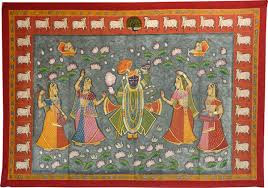
  Pichwai  are large devotional Hindu painted pictures, normally on cloth,  portraying  Lord Krishna. Pichwai paintings also known as "Pichvai" is a traditional Indian art having its origins in Rajasthan.

Pichwai  is a style of painting that originated over 400 years ago, in the town of Nathdwara near Udaipur in Rajasthan. The pichwai paintings, made on cloth, depict tales from Lord Krishna's life.
Originally Pichwai was painted on the handspun starched cotton fabric. The artisans would then sketch the art on that starched cloth. Then the decorative and beautiful images were created. The images were then ready to be painted with completely organic and natural colors, paints and even natural brushes.
The Pichwai style is from the Nathdwara School, and is identified by characteristic features of large eyes, broad nose and a heavy body, similar to the features on the idol of Shrinathji. Different paintings are made for different occasions, different seasons, festivals, and so on.
The work of Pichwai artists is intricate, detailed and visually stunning. Artists use tools such as brushes made from goat tail hair, coconut shells to hold colours, charcoal made from tamarind twigs and more. Shades of red, gold and stone make up the Pichwai colour palette.
The Pichwai paintings portray a variety of stories, including the life of Lord Krishna, Vallabhacharya's family history, cows, lotuses and many other beautiful patterns from nature. The major motifs were of cows, lotuses, Gopis , Radha Ji, peacocks and trees. 
The purpose of pichwais, other than artistic appeal, is to narrate tales of Krishna to the illiterate. Temples have sets with different images, which are changed according to the calendar of festivals celebrating the deity. To make Pichwai prominent for today, the artist has contemporized the artform without compromising its traditional touch.  A Pichwai now belongs everywhere. Because of their beauty and brilliance, Pichwais are now also hung on house walls and other places and are no longer restricted to the temples. Hence, the artists are now making paintings of smaller proportions, which are apt for the smaller homes of today.

(This blogpost is a part of BlogChatter's #BLOGCHATTERA2Z2023)

FRAGRANCE AT A DISTANCE

  Athar, Javadhu, colognes of delight, Brut in a bottle, glass catching light. Fragrances gather, they fill up the air, A new look is g...